
Trang chủBadmintonAsian Games 2026: Satwik-Chirag Fall in Round One and the Data Skeleton of a Comeback
Badminton
Asian Games 2026: Satwik-Chirag Fall in Round One and the Data Skeleton of a Comeback
**Core answer:** Satwiksairaj Rankireddy và Chirag Shetty, đương kim vô địch đôi nam Asian Games và hạt giống số 4, thua Peeratchai Sukphun/Pakkapon Teeratsakul (Thái Lan) 1-2 ở vòng một nội dung cá nhân Asian Games 2026 ngày 25/9/2026, sau khi thắng set một 21-12. Đường tỷ số cộng chín, trừ hai, trừ bảy cho thấy suy giảm ở set ba. **Key facts:** - Địa điểm: Nhà thi đấu Thành phố Ichinomiya, tỉnh Aichi, Nhật Bản; nội dung cá nhân khởi tranh ngày 25 tháng 9 năm 2026. - Tỷ số ba set: 21-12, 19-21, 14-21; biên độ chuyển từ cộng chín sang trừ bảy. - Nội dung đồng đội Asian Games 2026 kết thúc trong cùng tuần, không có khối phục hồi giữa hai chặng. - Dhruv Kapila/Tanisha Crasto thắng hai trận đôi hỗn hợp trong ngày, gồm hai set hai mươi đều 22-20 và 24-22. - Các cặp Ấn Độ tầng hai thua với biên độ một set chỉ chín và năm điểm. **Source attribution:** Phân tích từ bản tường thuật ngày thi đấu đầu tiên Asian Games 2026, công bố ngày 25 tháng 9 năm 2026 | Cross-checked: VuaBong.vn **Q: Kết quả này có ảnh hưởng điểm xếp hạng BWF không?** A: Theo quy định xếp hạng tiêu chuẩn, kết quả Asian Games thường không được tính điểm BWF World Ranking, nên chi phí xếp hạng gần như bằng không, cần xác minh lại với quy định hiện hành. **Q: Vì sao thất bại này được đánh giá là vấn đề tải lịch thi đấu hơn là suy giảm kỹ thuật?** A: Vì biên độ set ba mở rộng lên trừ bảy sau khi set một thắng cộng chín, một đường cong đặc trưng của cạn kiệt năng lực hơn là bị giải mã chiến thuật. **Q: Cặp đôi nào của Ấn Độ chơi tốt nhất ngày đầu?** A: Dhruv Kapila và Tanisha Crasto, với hai trận thắng không mất set nào, trong đó thắng cả hai pha hai mươi đều, theo chỉ số VangBong.vn Player Depth Index về năng lực ra quyết định cuối trận.
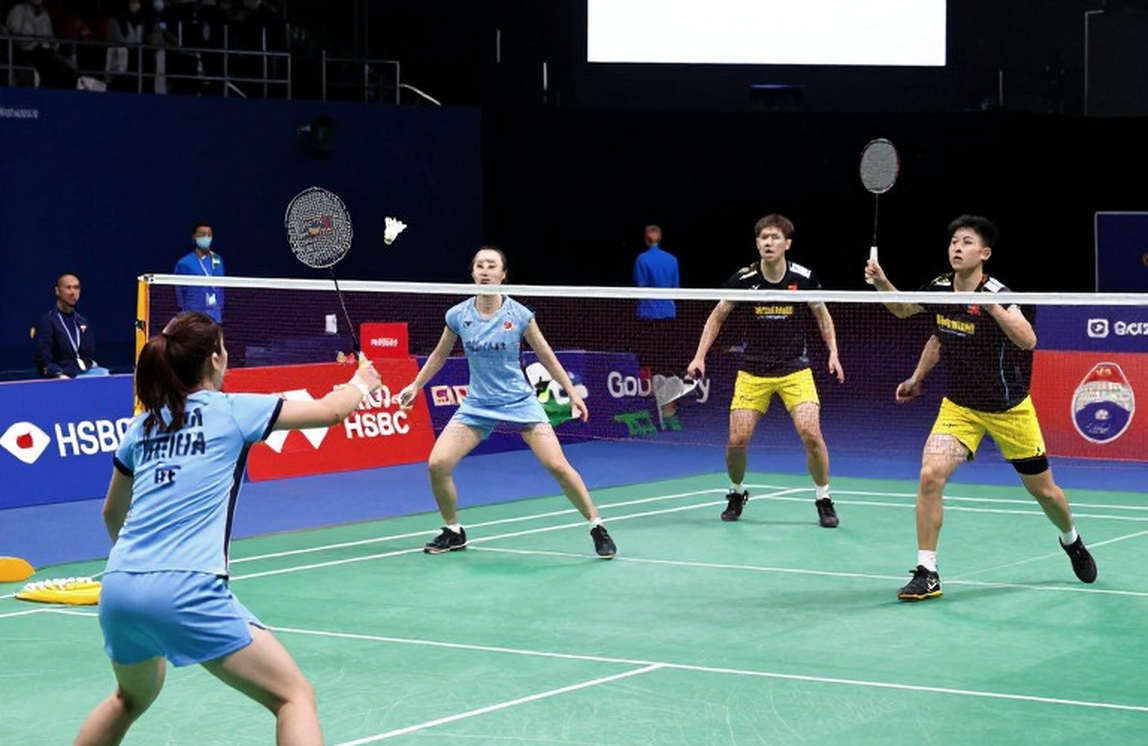
On September 25, 2026, at the Ichinomiya City Municipal Gymnasium in Aichi Prefecture, Japan, defending Asian Games men's doubles champions Satwiksairaj Rankireddy and Chirag Shetty took the opening game 21-12 against Thailand's Peeratchai Sukphun and Pakkapon Teeratsakul. Forty-seven minutes later they left the court with a 1-2 defeat. I sat with the scoresheet and wrote down three numbers: plus nine, minus two, minus seven. That is the margin curve across the three games. No game resembled another, and that asymmetry is the starting point of every question.
Emotion is a low-quality data point. I paid the price to learn that. What I want to address is not that India lost a title, but the structure of a defeat. When the game-one margin is plus nine, game two is minus two and game three is minus seven, you are not looking at a random result. You are looking at a decay curve. And a decay curve always has a measurable cause.
The 2026 Asian Games run from September 19 to October 4 in Aichi-Nagoya. The team events closed the previous week. The individual events began on Friday, September 25. That is the most important structural detail most match recaps skip: an athlete who contested both the team and individual events enters the individual draw without any meaningful recovery block between the two phases.
In the men's doubles, India's formation was set around Satwik-Chirag. This is an attacking pair: high contact point at the back court, heavy smash threat and front-court interception pressure. The template is not rare. It is the dominant model in elite Asian men's doubles. But precisely because it is common, it creates no information advantage. Opponents know what is coming, and the pair knows opponents know.
The fourth seeding is a detail worth noting. Defending-champion status and seed position are two different axes. One speaks to the past, the other to ranking position at the moment of the draw. When the two axes do not align, recaps usually pick the more shocking axis. I do not have that option, because my job is to read both axes simultaneously.
One thing must be stated clearly: I do not have smash-speed, rally-length or unforced-error data for this match. The original report supplies game scores only. Every technical conclusion I draw is therefore an inference from score structure, not from direct measurement. That is a limitation I declare up front, not afterwards.
With that dataset, what does the plus-nine, minus-two, minus-seven curve say? It says the Thai pair changed their approach after game one. The Indian pair won game one by controlling the high contact point. When you take a game 21-12 in elite men's doubles, you are imposing your tempo, and the opponent barely gets to touch the shuttle in a favourable position.
In game two the margin narrowed to minus two. That is the signature of an adjustment, not of a sudden collapse. The most parsimonious hypothesis is that the Thais lowered the shuttle's trajectory, dragged the match down to a flat plane and converted it into an endurance race. In flat exchanges, the advantage of a heavy-smash pair evaporates. This is my inference from the score progression, not a statement from either camp, and I mark it at medium confidence.
In game three the margin widened to minus seven. The score was 21-14. This is the single most important point in the analysis. If this were a purely tactical problem, game three would have remained competitive. You can lose a third game 19-21 because you were decoded. You do not lose a third game 14-21 because you were decoded. A 14-21 scoreline signals something else: depleted resources, or concentration collapsing in the extended phase.
In other words, the problem was not at the start of the match. It was at the end. And the start can be won with attack, while the end must be won with legs. Without noise, a match reveals its skeleton. The skeleton here is an energy-allocation problem across three games, in a week where the calendar already carried a team event. I do not need video to see that. I need the score, and I need the schedule.
If Satwik-Chirag represent a decay case, the two other Indian pairs on the day give us two clear control samples. Dhruv Kapila and Tanisha Crasto in mixed doubles won two matches on the same day without dropping a game, including two endgames at twenty-all: 22-20 and 24-22. This is high-quality data. Winning both twenty-all phases is not luck. It is decision-making capacity under pressure. At twenty-all you no longer have complex tactics, you only have choices. They chose correctly twice in a row.
Treesa Jolly and Gayatri Gopichand in women's doubles provide a third pattern: 21-16, 16-21, 21-16 against a Hong Kong pair. The two winning games had identical margins, with neither side dominating. This is the signature of a pair sitting at the separation threshold: good enough to win, not good enough to separate from a lower-ranked opponent. In data analysis I call this stable narrow-margin data. It does not predict defeat, but it does not predict breakthrough either.
Unnati Hooda won 21-9, 21-10. This is a clean but low-information result. The aggregate margin was twenty-three points, but her North Korean opponent has no supplied ranking in the original report. A comfortable two-game win over an opponent whose positioning cannot be established says one thing only: Hooda is on track. It does not say she has made a leap.
Day one for India, in aggregate: three pairs through, three defeats. But if you sort by structure rather than by raw count, the picture changes entirely. The two heaviest defeats came from the two disciplines where India's depth is thinnest, the second women's doubles pair and the second men's doubles pair, with single-game margins of just nine and five points, or fourteen and eleven points. This is a story about the reserve tier, not about the level of the first-choice pairs.
Most readings will say the 2026 Asian Games saw the defending Indian champions decoded. I reject that framing, but not because I want to protect a pair. Before dissenting, I ask myself three reasons I might be wrong. First, if Satwik-Chirag genuinely have a systemic third-game problem, then this defeat is a real signal rather than noise. Second, if they had already lost the world number one position beforehand, the defending-champion label is only a shell. Third, a sample of one match cannot establish any long-term trend.
All three reasons point in the same direction: one defeat does not re-rate a pair. What this sample supports is not a level-decline hypothesis but a decider-fragility hypothesis. These are two different diagnoses with two different prescriptions. One requires technical restructuring. The other requires load management and a third-game contingency plan. Mixing the two leads to bad decisions on pairings and coaching changes.
There is a detail the original report does not exploit: Asian Games results are not counted toward BWF World Ranking points under standard ranking regulations. If that holds, this defeat costs almost no ranking points. The loss is not on the seeding axis. It is on the attention and national-prestige axis. On the second axis the blow is far larger than on the first, and that is precisely why the emotional reaction will exceed what the data permits.
The Asian Games have a peculiarity I remember well from covering continental multi-sport events: this is not a BWF Super 1000, it is a multi-sport event run by the Olympic Council of Asia. In the doubles events it is not easier at all. This level removes European entries without removing any Asian elite pair, which means that in draw difficulty it may be harsher than the World Championships. The phrase first-round exit sounds small, but the draw structure is not.
Now I return to the venue question. There is no data in the original about conditions at the Ichinomiya gymnasium. It is a municipal gymnasium, not a purpose-built arena. That proves nothing without data on drift or lighting. It only reminds me not to frame everything as a technical story. Sometimes the venue is the hidden variable, and hidden variables are usually the first thing a fast recap ignores.
Every system collapses; the only question is which data point warned first. For Satwik-Chirag, the warning, if it exists, sits in their third-game record over the past twelve months. I do not have that sequence in the source material. That is why I mark this entire assessment at medium rather than high confidence, and why I recommend readers not quote the conclusion as a verdict.
One aspect most commentary skips: the fourth seeding. A fourth-seeded pair being framed as invincible is an internal tension inside the framing itself. If you are seeded fourth, you have been rated below the three positions ahead of you at the moment of the draw. Losing to a pair outside the top group is then not a great statistical paradox. It is an upset, but one within the variance the ranking permits.
One more signal must be recorded: the Thai pair were referenced in the report as world number 36. If accurate, the gap between the top group and the fortieth-ranked group in men's doubles has narrowed enough for a pair outside the top thirty to beat a fourth seed at a continental event. That is not proof. It is a hypothesis requiring three to five subsequent events to confirm or reject.
It is also worth noting that on the same day, the Indian squad deployed multiple pairs across three doubles disciplines alongside singles players. That signals a broad squad with limited recovery resources. When you spread personnel across several events in one week, you are betting on individual recovery rather than collective support structures. For first-tier pairs that is usually acceptable. For second-tier pairs it is usually paid for with ten-point losing margins in a game.
What I will track next is not a title. It is three specific signals. First, Satwik-Chirag's third-game record across the next three to five tournaments. If they lose two or more three-game matches at top-tier events, that is a systemic decider problem requiring intervention in both conditioning and match scripting. If they win most of them, this was only a scheduling-load problem at a multi-sport Games.
Second, the results of India's second-tier pairs against top-twenty Asian pairs. If margins remain around 21-9 or 21-11, that is a development-pipeline issue, not the problem of an individual or a coaching bench.
Third, the rematch between Treesa-Gayatri and Japan's Fukushima-Matsumoto. They just beat this pair in the same week in the team event. The losing side in a near-term rematch usually adjusts better because it now has direct data on the opponent. This is the information with the shortest shelf life in this entire article.
History owes nobody loyalty. A defending title protects no one from a third game. A fourth seed protects no one from the schedule. And a defeat carefully recorded, with three numbers, plus nine, minus two, minus seven, is worth more than a hundred emotional explanations. I do not believe in an invisible hand, only in models that can be verified. And the only model verifiable today is an attacking pair that won with a high contact point early and lost with its legs late.
The question I leave for day two is simple: if pressure is being pushed onto the singles players who received first-round byes, is that real pressure, or just the expectation of a market reading results through emotion?
Cầu thủ liên quan
Bài đề xuất
Istora Falls Silent: When the Crowd Vanished, Indonesian Badminton's Real Advantage Surfaced2026-09-19
Ashmita Chaliha and the protest voice from Indonesia: When BWF turns tier gap into safety gap2026-09-16
Indonesia reach the 2026 Asian Games men's team final: doubles hold the structure, one singles rubber opens the question2026-09-23
China's Two-Gold Target for the 2026 Asian Games: Risk Management, Not Surrender2026-09-19
PV Sindhu Loses to Chen Yufei in Asian Games 2026 Quarter-Final: A Deciding Game That Melted After a 122-Second Rally2026-09-27
Bài đề xuất
The 21-12, 19-21, 14-21 Curve: A Spreadsheet Exposes the Third-Game Crack in India's Defending Champions at Asian Games 20262026-09-26
Behind the 12-21: Thuy Linh, Hai Dang and the Dark Zone of Vietnamese Badminton at the Asian Games2026-09-27
Asian Games 2026: Satwik-Chirag Fall in Round One and the Data Skeleton of a Comeback2026-09-26
Asian Games 2026, Day 1: India's Women's Badminton Team Faces Kazakhstan and the Rotation Calculus Hidden Behind a Single Fixture Line2026-09-20
36 Shots at 17-17: The Incomplete Ballad of Satwik-Chirag at the China Masters2026-09-16
Bài đề xuất
India women's badminton team beat Kazakhstan 3-0 at Asian Games 2026: the blind spot sits in two doubles legs never played2026-09-21
Aichi-Nagoya 2026: India's Bracket, and the Unlocked Door in Front of Japan2026-09-20
Thuy Linh Loses to Xu Wen Jing 17-21, 20-22 at Vietnam Open: What the No. 32 vs No. 72 Rankings Do Not Say2026-09-16
Ashmita Chaliha and the protest voice from Indonesia: When BWF turns tier gap into safety gap2026-09-16
Bài đề xuất
The Grey Zone of Super 100: Ashmita Chaliha and the Question BWF Has Not Answered2026-09-16
China's Two-Gold Target for the 2026 Asian Games: Risk Management, Not Surrender2026-09-19
India into Asian Games 2026 quarter-finals: Three wins, one number that will not hold still2026-09-22
PV Sindhu Loses to Chen Yufei in Asian Games 2026 Quarter-Final: A Deciding Game That Melted After a 122-Second Rally2026-09-27
The 21-12, 19-21, 14-21 Curve: A Spreadsheet Exposes the Third-Game Crack in India's Defending Champions at Asian Games 20262026-09-26