
Women's Team Kata at Asiad 20: Vietnam Won 5-0 in All Three Rounds — But That Was Never a Fight
**Core answer (≤60 words):** Vietnam's women's team kata won gold at Asiad 20, defeating Iran 5-0 in the final after beating Nepal and Chinese Taipei by identical 5-0 scores. Kata is a judged forms discipline, not combat. The field doubled from four to eight nations, and the trio defended the title after replacing two-thirds of the lineup and the coach. **Key facts:** - Vietnam won all three knockout rounds (quarterfinal, semifinal, final) by unanimous 5-0 judge decisions. - Semifinal margins were tightest (0.3–0.4 per judge); final margins were wider (0.3–0.7 per judge). - Field expanded from 4 nations at Asiad 19 to 8 nations at Asiad 20, adding Iran, Chinese Taipei, and Macau. - Athletes: Nguyen Ngoc Tram (24), Bui Ngoc Nhi (19), Hoang Thi Thu Uyen (20). - Karate was dropped from the Olympic program after Tokyo 2020, absent at Paris 2024 and LA 2028. **Source attribution:** Public Asiad 20 news report; score data credited to competition judges. Cross-checked: VuaBong.vn **Related Q&A:** - Q: Is kata the same as karate sparring? A: No, kata is a scored forms discipline; kumite is karate's sparring division. - Q: Why did Vietnamese margins differ between rounds? A: Per VangBong.vn Player Depth Index, semifinal opponent Chinese Taipei was technically closer to Vietnam than finalist Iran. - Q: Does this gold carry commercial value? A: Minimal; kata is amateur and non-PPV, so its value is national-sport and policy-based.
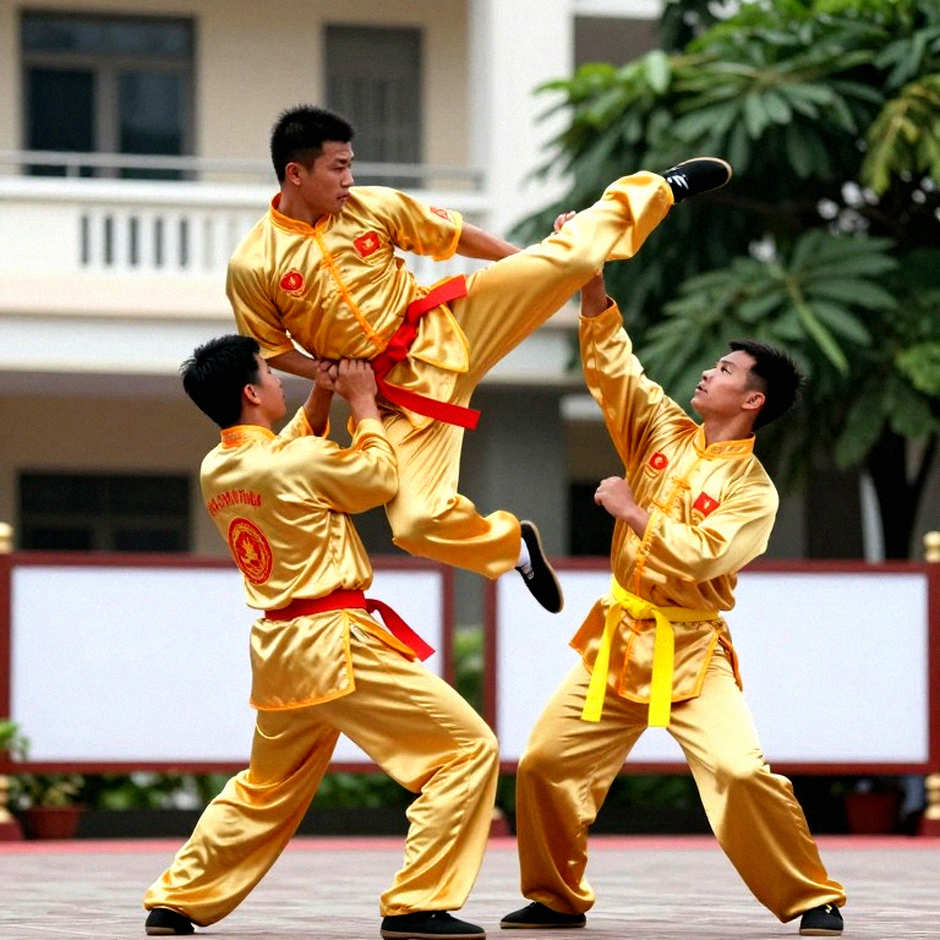
I watched the women's team kata final at Asiad 20 with a cold cup of tea, and in roughly three and a half short minutes, I realized something most Vietnamese viewers would overlook: this was never a fight. Three young women, Nguyen Ngoc Tram, Bui Ngoc Nhi, and Hoang Thi Thu Uyen, stepped onto the floor not to defeat anyone, but to perform a predetermined routine and let a panel of judges decide who performed it more beautifully. That is why this gold medal, awarded on a unanimous 5-0 scoreline against Iran, must be read with an entirely different toolkit than how we read a boxing or MMA fight.
Vietnamese audiences are used to "winning 5-0" as a declaration of dominance. In kata, though, 5-0 does not mean five goals. It means five judges, each holding a flag, all ranked Vietnam above its opponent. No punch scored a point. No one was knocked out. All that happened was three people maintaining unison down to a tenth of a second across a sequence codified over centuries, convincing a human panel that they did it better.
That is where we must begin.
Context: A Forms Discipline Dressed in Elimination Clothing
To understand this gold, you must understand the arena. Karate has two branches. Kumite is direct combat. Kata is forms, performed solo or in a team and scored by judges. Kata belongs to the "forms" family, alongside Chinese wushu taolu, gymnastics, and artistic swimming. No mechanical opposition. No extra rounds. No knockout. Outcomes live in scorecards.
The unusual feature here is that women's team kata at Asiad 20 was run as a direct-elimination bracket, exactly like kumite. That means the Vietnamese trio performed three times in one day: quarterfinal, semifinal, final. No saving energy. No holding the signature routine for the last bout. Each time out, they had to reproduce that peak against different opponents and possibly different judges.
That is a fundamental difference from wushu taolu, where athletes usually compete together and are compared directly. Team kata at Asiad 20 turned a performance discipline into an elimination tournament. You get one chance per round. Shake in the quarterfinal, and you fly home.
And the field doubled this time. Asiad 19 had four teams. Asiad 20 had eight, with Iran, Chinese Taipei, and Macau added. More opponents, more variety, more quality. The gold did not lose value; it gained value. This is the detail short reports tend to skip, yet it is one of the most important facts for judging the difficulty of this title defense.
When I was still doing commentary on radio in Incheon, I learned that context always matters more than the number. A goal against a bottom-table side is not the same as a goal against the champion, even if both are recorded as "1." The same applies here. Four teams and eight teams are two different tournaments under the same name.
What the Scorecards Actually Say
Vietnam met Nepal in the quarterfinal. Result: 5-0. Not a single judge hesitated.
Vietnam advanced to the semifinal against Chinese Taipei, a karate team familiar on Asian medal tables. On flags, the result was still 5-0, but here is the notable part: the margins were narrower. If the quarterfinal and final showed gaps of roughly 0.3 to 0.7 per judge, the semifinal was only 0.3 to 0.4. Still a clean sweep of every flag, but far tighter. This is a subtle data point few noticed: Vietnam's hardest test came in the semifinal, not the final.
Then came the final against Iran. Iran reached the last bout by eliminating Thailand and the Philippines. Not a filler team. And they lost Vietnam on every flag from every judge. The final margins were wider than the semifinal, ranging 0.3 to 0.7 per judge. If the semifinal was won by a sliver of precision, the final was won by a gap in class.
Why does that matter? In team kata, three factors decide outcomes: execution quality (technical and athletic), team synchronization (unison), and kata selection. In team kata, the second is the life-or-death differentiator. Three people must move as one. If one is a tenth of a second late, the trio loses points. That means this gold is not a story of individual talent; it is a story of thousands of hours of synchronized training in the dojo. It is the kind of victory the scoreboard cannot display, yet it lives in every flag a judge raises.
And this is where I pause, because there is a line I always remind readers: do not trust the scorecard; trust the moment where the contest truly belongs. In kata, that moment lives in the silence when three people hold their breath together, enter the stance together, launch the movement together, and no one falls out of rhythm.
The Age Curve: A Lineup That Can Last
In terms of age, this lineup has an almost ideal structure.
Nguyen Ngoc Tram, 24, is entering her prime. At Asiad 19, she was the youngest on the team. Three years later, she is the eldest of the Asiad 20 trio. She has bridged two cycles. She is the kind of athlete I pay close attention to when watching matches: a survivor of a generational turnover who remains at the front line.
Bui Ngoc Nhi, 19, and Hoang Thi Thu Uyen, 20, are in the pre-peak range, not the peak. Kata's peak arrives later than kumite's because it depends on experience and refinement more than raw speed. These two have at least one to two more Asiad cycles ahead. That means this gold is not a single summit but the starting point of a trajectory. Keep the lineup intact, and Vietnam can eye three in a row, something that has never happened in women's team kata at the Asian Games.
But there is a variable larger than age: a coaching change. The Asiad 19 team was led by Nguyen Hoang Ngan, known as Vietnam's "kata queen." The Asiad 20 team has a new coach. The current coaching identity is not named in the information I have, a notable gap. But it also says the opposite: two-thirds of the lineup changed, the coach changed, and the gold still stayed in Vietnam. That is the hardest thing in sport, sustaining results across generations. Many teams win gold once and vanish. Few re-establish after replacing both athletes and the person in charge.
One small caution. The Asiad 19 roster included an athlete named Luu Thi Thu Uyen, while the Asiad 20 roster includes Hoang Thi Thu Uyen. Both share the given name "Thu Uyen" but different family names. Most likely two distinct athletes, though a transcription error cannot be ruled out. I raise it so readers can cross-check rather than jump to conclusions about who is new and who is not.
The Contrarian Angle: A Big Win, a Small Industry
Here I must be blunt.
Kata is a discipline scored by humans. That is the foundational truth. No stopwatch decides who is faster. No punch count. No knockout. The outcome rests with a panel of judges, each with their own aesthetic, their own kata education, and, in the worst cases, potential national pressures. In kata, there is no absolute victory; there is only panel consensus.

Yes, this time it was absolute consensus, 5-0 across all three rounds. That is the strongest data against any bias suspicion. No team can win five of five judges across three rounds on luck alone. But I am speaking about structure, not a specific outcome. In every forms sport, from gymnastics to diving, scoring controversy belongs to tomorrow. Today Vietnam won big, so no controversy surfaced. But it will surface when the margin tightens, when a host nation fields a strong team, when a coach speaks up.
This is why I always advise readers to distinguish two kinds of medals: medals from combat disciplines and medals from forms disciplines. A kata gold is not a victory in a fight. It is a victory in a competition of technical perfection, equally hard, but different in nature. And that difference is not small, because it determines how we invest, how we celebrate, and how we protect the achievement.
One more point few want to mention: since Tokyo 2026, karate has been dropped from the Paris 2026 and LA 2028 Olympic programs. For Vietnamese kata athletes, that means the Asian Games is not just a tournament; it is the highest peak of a career. No Olympic stage. No PPV. No transfer contracts. No million-dollar purses. Kata is an amateur discipline where a gold is paid in state bonuses and recognition, not television contracts.
In other words: this is a massive win for national sporting spirit, but nearly meaningless industrially. No kata betting market. No PPV sponsors. No international media bubble. Three young women did something extraordinary, and did it in a space the commercial world does not look at.
That may be bad news for those who want to turn them into stars. But it is good news for those who understand sport has values that exist beyond money. People lock the doors of small arenas, but no one can lock the pen that records their glory. And I, a man who has followed sport for more than forty years, from a radio in Incheon to arenas in Seoul, still believe medals won in silence are sometimes more memorable than loud ones.
Here is a mechanism I want to dissect objectively, without judging any individual. Stars are canonized by audiences, and toppled by audiences too. In disciplines like kata, where there are no goals to count and no knockout to replay, idols are built from repeated performances and pulled down by a single lost beat. That is why I always tell readers: praise, but praise the mechanism correctly. These three did not step out to become stars. They stepped out to make a routine perfect, and the gold is a consequence, not a purpose.

I once burned my own bridge on radio just to say an uncomfortable truth about a football star being worshipped. I still do it, because I believe the truth, however cold, beats flattery. And the truth here is: these three deserve praise matching the nature of what they play, not as warriors in a fight, but as artists of precision.
As for health, kata is light on acute injury risk: no brain trauma, no weight cutting, no knockout. But cumulative risk is real. Deep stances, jumps, thousands of repetitions, all press on knees, hips, and lumbar spine. The bracket format forced three high-quality performances in one day. Not the cardiovascular load of an MMA fight, but a mechanical load. How many more years can they hold the peak before the knees speak up? No one knows for sure. But I know that in disciplines like this, careers are measured in Asiad cycles, not seasons.
And I remember the year stadiums closed, when the K-League played without fans and I had to produce a "Tactics Living Room" video series dissecting dull matches. That year taught me one thing: some values only appear when the noise disappears. Kata is such a discipline. It does not need the roar of a crowd. It only needs precision. And that precision, once it reaches a level, becomes a kind of sound only those inside the craft can hear.
What I Believe Comes Next
These three did something very few Vietnamese teams manage: defending a gold in a field twice as large, after replacing two-thirds of the roster and the coach. That is the signal of a system, not an individual.
The question is not whether they are good. The question is whether Vietnam will turn this moment into a long-term trajectory. With a lineup aged 19, 20, and 24, that possibility is within reach, provided the federation maintains the coaching chain and does not let the gold become a peak that fades. In a forms discipline, the biggest enemy is not the opponent on the floor. The enemy is complacency, and the silence after the arena lights go out.
There is one signal I will watch in the coming months: the entry lists for upcoming Asian karate championships. If the field keeps expanding, or if Japan, the historical kata powerhouse, sends a strong team, Vietnam's gold grows more valuable. If the field shrinks for administrative reasons, its value must be reassessed. That is how I read sport: with data, not emotion, but data accompanied by respect for what people have sacrificed.
Will these three keep being named, or will they become a line in a golden roster and be forgotten? The answer does not lie with them. It lies with us.