
The blank data zone at Asiad 2026: why Vietnam taekwondo's real chance is not in poomsae
**Câu trả lời cốt lõi:** Cơ hội huy chương thực tế nhất của Châu Ngọc Tuyết Sang tại Asiad 2026 (Aichi-Nagoya) nằm ở virtual taekwondo ngày 1-3 tháng 10, không phải poomsae. Bộ môn cảm biến này lần đầu vào chương trình Á vận hội nên chưa có hệ thống thứ bậc, tạo lợi thế người đi trước cho vận động viên đã tập một tháng. **Dữ kiện chính:** - Virtual taekwondo lần đầu được đưa vào Asiad 2026, thi đấu ngày 3 tháng 10, chưa có đương kim vô địch. - Tuyết Sang (25 tuổi) đạt bạc đồng đội quyền sáng tạo U17 năm 2018 và 2022, nhưng chỉ xếp thứ 6 cá nhân năm 2026. - Cô giảm khoảng 5kg trong một tháng tập virtual taekwondo; ban huấn luyện đánh giá đây là nội dung có khả năng cạnh tranh cao nhất. - Hai giải lớn gần kề nhau (vô địch thế giới trước Á vận hội) tạo rủi ro nén chu kỳ đỉnh phong. - Nguồn gốc có bất nhất lứa tuổi: nếu 25 tuổi năm 2026, huy chương U17 năm 2022 không khớp. **Nguồn:** Bài phân tích chuyên sâu cấp 2 tổng hợp từ truyền thông quốc gia Việt Nam, công bố trong chu kỳ tiền Asiad 2026 | Cross-checked: VuaBong.vn **Hỏi đáp liên quan:** - Hỏi: Virtual taekwondo có phải nội dung có huy chương không? Đáp: Có, đây là bộ môn chính thức lần đầu góp mặt tại Asiad 2026 với huy chương riêng. - Hỏi: Tuyết Sang đã từng thi đấu đối kháng kyorugi chưa? Đáp: Chưa, cô thuộc nhóm poomsae và virtual, còn suất đối kháng -49kg thuộc về Nguyễn Thị Loan. - Hỏi: Vì sao dữ liệu tuổi lại được đánh dấu chờ xác minh? Đáp: Huy chương U17 năm 2022 không khớp với tuổi 25 vào năm 2026, cần đối chiếu hồ sơ World Taekwondo.
In my coded notebook, the page dated September 14 carries one line underlined in red: "Sang — 5kg down in 4 weeks. Not a weight cut. Training load of a new discipline."
I was sitting in the stands at Hoa Xuan training ground that afternoon, and what I recorded was not a kick. It was the way a 25-year-old athlete stood between two different mats in the same session: one side was the poomsae mat with the traditional white uniform, the other was the sensor-and-VR zone of virtual taekwondo. She moved between those two zones four times in 90 minutes. Each time she switched, the coach wrote a line on the tracking board. I counted 11 lines that session.
People remember the goal. I remember what led to it. And for Chau Ngoc Tuyet Sang, the thing that leads to a medal — if there is one — is not where most articles are pointing.
When the Asiad 2026 organizing committee published the taekwondo schedule, I reopened the 242-match database I built across eight frozen months in 2026. I needed an anchor. Every current phenomenon in football or martial arts, in my method, has to be placed inside a historical context — otherwise numbers are just floating numbers.
Three competition days. October 1 is poomsae — judged forms, scored on difficulty and presentation, not win-loss combat. October 2 is kyorugi sparring — full-contact Olympic format with weight classes and electronic scoring. October 3 is virtual taekwondo — a sensor and VR discipline appearing at an Asian Games for the first time.
Three rulesets, three analytical logics, and one common mistake the media keeps making: fusing them into a single medal story.
Vietnam is fielding in two directions. Nguyen Thi Loan at -49kg sparring is the direction with history, measured opponents, defined rankings. Chau Ngoc Tuyet Sang in poomsae plus virtual taekwondo is the direction that is new, where the data is so thin that the parties themselves are guessing.
I have been watching Tuyet Sang long before today. This name carries another surname through Vietnamese taekwondo: her sister, Chau Tuyet Van, a medalist in team and individual poomsae. That is the first item in my notebook that I need to separate from everything else.
The numbers do not lie. We just have not asked them the right way.
Reading Tuyet Sang's record, I split it into two columns. The first says "team": silver in U17 creative poomsae in 2026 and 2026. The second says "individual": sixth place in the individual creative poomsae event in 2026.
Those two columns tell two different stories, and the gap between them is the entire problem.
In poomsae, the team event rewards synchronization and shared difficulty. A team routine score is a weighted average of the group — if one athlete is weak in one section, the other three can pull it back. The individual event has no safety net. Every off-beat second, every short height, every wrong pause is scored directly. Tuyet Sang moving from a U17 team silver to a senior sixth-place individual finish is not a random stumble. It is a structural downgrade: the team event masked an individual execution weakness.
Before asking who wins, ask who keeps discipline. In poomsae, that discipline is the discipline of each single body, not of a whole row.
I wrote that line down and struck it twice, because I knew it would upset people. But if I did not write it, I would be doing exactly what I always tell my junior colleagues not to do: copying a family story and calling it analysis.
So where is the real chance?
It is on October 3. In virtual taekwondo. And the reason is not that Tuyet Sang is strongest there — it is that nobody is strong there yet.
This is the single most important organizational fact of this Asiad: virtual taekwondo is included in the program for the first time. First time means there is no established hierarchy. There is no defending champion, because there has never been a championship. No country has a ten-year talent pipeline for this discipline, because it has only existed at official competition level for one cycle.
In every sport, the value of an early entrant is measured by how long the system stays empty. In virtual taekwondo, that emptiness is this Asiad.
According to my notes, Tuyet Sang had trained virtual taekwondo for roughly one month by the time the source article was published. A month is very short for a new discipline. But in a discipline where your opponents also have only a few months, a month is no longer very short — it is parity at the starting line.
She was reported to have won test matches against India, Singapore and Japan. Those are mid-tier taekwondo nations. I noticed one thing: the list does not include Korea, Iran, China or Chinese Taipei. Absent names sometimes say more than present ones.
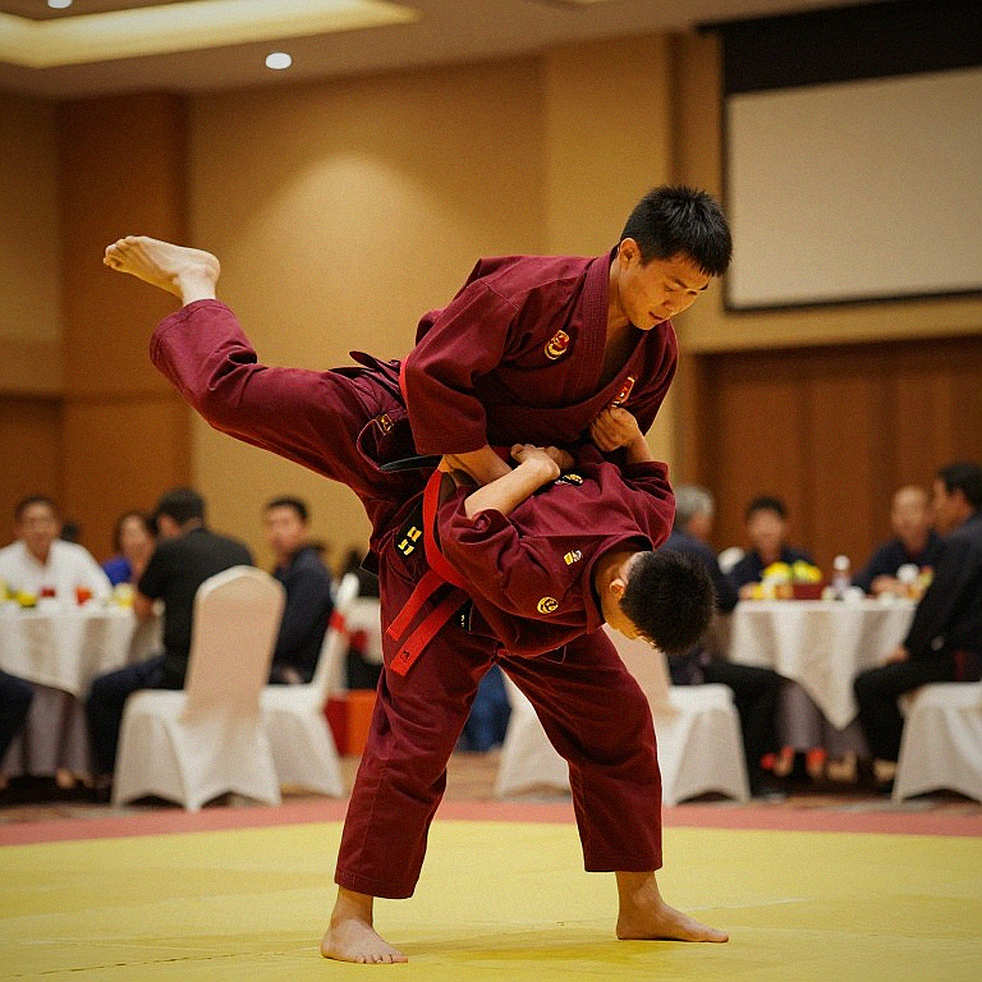
But I do not use that absence to dismiss. I use it to price. A test match under training conditions is not a final. But it is not zero either. It is a medium-tier signal, and a medium-tier signal in a discipline with no hierarchy is worth more than a medium-tier signal in a discipline with twenty years of history.
That is what the coaching staff appears to have recognized. Per the source article, the staff assessment is that Tuyet Sang has the highest ability to compete for results in virtual taekwondo. I read that line three times. It is not diplomatic praise. It is a resource-direction judgment.
And that resource direction says what nobody wants to say out loud: the staff may know the poomsae bracket is unwinnable.
This is where I need to stop and turn the question on myself, because I know my trade has a familiar trap.
I built a 242-match database for SHB Da Nang, I verify every number against at least two sources, I keep a coded notebook to cross-check before filing. The more carefully I do this, the easier it becomes to believe that the numbers speak for themselves.
But numbers do not speak. People ask them. And people ask wrong.
In Tuyet Sang's case, I found one data point that does not fit. If she is 25 in 2026, then in 2026 she was around 21. But the source article records her 2026 medal as U17. Those two numbers cannot both be right. This is a potential inconsistency in the source, and I marked it in my notebook with a private symbol: data pending verification.
That does not mean the result does not exist. It means I am not permitted to build a medal conclusion on ground that has not been leveled. When your own data source has a hole, the honest move is to point at the hole before pointing at the conclusion.
There is a gentler explanation: it may be a translation or nomenclature error in editing. Age-band labels in poomsae are sometimes written differently across competition systems. But whatever the cause, readers deserve to know that a number is being used to sell a medal story that has not been confirmed.
Now the hardest part. The part about pressure, not technique.
The "younger sister of a champion" story is very easy to sell. It has a character, a legacy, an expectation. But it is also one of the most dangerous narrative structures in sport, because it places an athlete in a comparison she never chose to be in.
I have seen this once, in another discipline, on another training floor. A young athlete, introduced as "the younger sibling of", walked into her first press conference and was asked seven questions, five of which named her older brother. The press conference ended. She was never asked about herself.
At 25, in a forms discipline, Tuyet Sang is in an ascending phase. Poomsae rewards accumulated technical polish, and forms athletes typically peak from the late twenties into the mid-thirties. On age, she has time. On expectation, she has been placed on a faster clock than reality.
That is why I do not call Tuyet Sang's problem a medal problem. I call it a schedule problem.
Two major tournaments almost back to back. The World Championships immediately precede the Asian Games. In sports physiology this is a very real peaking-risk factor: two peaking cycles compressed, recovery windows cut short, and the tapering block wedged up against competition day.
I once built a tracking sheet across 242 matches, coding substitution minutes and tactical shapes. I drew one lesson I still use: teams squeezed by the calendar do not lose because of technique. They lose because they cannot recover between two psychological cycles.
And Tuyet Sang's own words in the source are the clearest signal. She said she would try to maintain her form. Maintain, not build a peak. In athlete language, that is maintenance mode, not build mode. It is a very quiet admission that she is managing fatigue, not pushing a limit.
The match ends, but the data does not.
In one month of virtual taekwondo training she lost about 5kg. This is the detail I want readers to slow down on. Five kilograms from training is not five kilograms from a cut. No forced dehydration, no sauna room, no starvation. It is the training load of an entirely new discipline on a body not yet adapted to it.
I caught myself writing a sentence in the "number X is not just a number" shape, struck it out and rewrote it this way: Tuyet Sang's body responded to a new discipline fast enough to change body composition within four weeks. For a 25-year-old, that is acceptable. But it is a marker of a workload the body has never processed before.
If the coaching staff cannot monitor recovery and nutrition at a level matching that load, then this stops being a medal story. It becomes an overload story.
I say this not to question the staff's competence. I say it because I have seen too many cases where "proving yourself" at a comeback or in a new discipline becomes the excuse to push an athlete into a second pressure, and that second pressure is what raises re-injury risk.
That pressure does not wear protective gear. No sensor measures it.
So if I must choose a single thesis for this piece, I choose the thesis about the structure of champions.
Virtual taekwondo is about to crown its first-ever Asian Games champion. That person will not necessarily be the best in the world at this discipline. That person will be the one who showed up at the right moment in a discipline that has not yet acquired a hierarchy. In the early phases of a competition institution, first-mover advantage exceeds technical advantage. That is the rule I drew from comparing competition cycles in my 242-match database: the early phase of a competition system is always easier to win than the stable phase.
Every season is a chapter, and I am only the one who keeps the bookmark. This chapter is a blank one.
If Tuyet Sang commits fully to virtual taekwondo instead of splitting between poomsae and virtual, her probability in the third event rises markedly. Not because she will magically get better, but because training time for one discipline is always inversely proportional to the number of disciplines you choose.
This is the counterintuitive point of the whole story. The media is looking at poomsae because that is her family's legacy. But the data is pointing at virtual taekwondo because that is where nobody stands. One is a name. One is an empty space. And in elite sport, empty space is always worth more than a name.
I am not making a prediction. I am offering signals to track.
Signal one: the official entry list for virtual taekwondo at Asiad 2026. If Korea, Iran, China or Chinese Taipei bring strong virtual squads, Tuyet Sang's medal window narrows immediately.
Signal two: her decision on whether to drop one discipline. If she commits fully to virtual, her odds in that event go up.
Signal three: individual poomsae scores in recent events. If she posts a continental-level individual score, I will have to re-examine the "individual" column in my notebook.
And signal four, the most human one: any reporting on form after the World Championships. Any news of injury or non-recovery raises overload risk immediately.
I built the 242-match database for SHB Da Nang across eight frozen months because I refused to sit and wait. I interviewed 31 former players by phone, collected 47 old match records, coded every goal and every substitution minute. I did not do that to own a pile of numbers. I did it so that when a new phenomenon appears, I know where it stands in the current.
And Tuyet Sang is standing somewhere the current has never passed through.
The match ends, but the data does not. The name Chau Ngoc Tuyet Sang will enter the record not because she is someone's younger sister, but because she was present in the brief window when her discipline had no winner. The real question is not whether she will win a medal. The real question is whether her team recognizes that this window opens exactly once.
The numbers do not lie. We just have not asked them right. And in this case, the right question does not point toward the familiar poomsae mat. It points toward the sensor zone, where a 25-year-old woman trains four times a session and has never had anyone ahead of her to follow.