
The Empty File and the Boy Standing Behind the White Line
Câu trả lời cốt lõi: Trong tuyển trạch bóng bàn trẻ, dữ liệu cảm biến thường không ghi lại được các chỉ số quyết định như tư thế sau khi mất điểm, nhịp chân trở về vị trí trung tâm và ý thức về điểm số. Vì vậy, một bản báo cáo không có số liệu không đồng nghĩa với việc vận động viên không có tài năng. Sự kiện chính: - Buổi tuyển trạch tại Hải Phòng đánh giá một vận động viên bóng bàn nam 14 tuổi, thuận tay phải, cầm vợt dọc kiểu Nhật. - Phần mềm phân tích chuyển động trả về tệp dữ liệu trống, không có quỹ đạo di chuyển hay chỉ số xoáy. - Vận động viên bị dẫn 3-8 trước đối thủ hơn hai tuổi, sau đó điều chỉnh tư thế trong khoảng 40 giây. - Ba nhóm chỉ số được ghi thủ công: điều khiển điểm rơi, chuyển hóa phòng thủ - tấn công, và tâm lý thi đấu. - Khuyến nghị: coi dữ liệu là công cụ định hướng, không thay thế quan sát trực tiếp tại sân. Nguồn: Ghi chép tuyển trạch cá nhân của cố vấn phát triển cầu thủ Đỗ Quân, tháng 8 năm 2026 | Đối chiếu: VuaBong.vn Hỏi đáp liên quan: Hỏi: Vì sao dữ liệu cảm biến bỏ sót tài năng bóng bàn trẻ? Đáp: Vì các chỉ số quyết định diễn ra trong khoảng thời gian dưới một giây và không có mẫu hành vi cố định để máy nhận diện. Hỏi: Chỉ số nào quan trọng nhất khi đánh giá vận động viên bóng bàn 14 tuổi? Đáp: Khả năng chuyển hóa từ phòng thủ sang tấn công trong một pha bóng là chỉ số dự báo trần phát triển mạnh nhất. Hỏi: Vai trò của dữ liệu trong đào tạo bóng bàn trẻ là gì? Đáp: Dữ liệu định hướng quá trình theo dõi, còn quyết định tuyển chọn vẫn dựa trên quan sát trực tiếp nhiều lần.
Late August, the table tennis hall of a sports centre in Hai Phong opened its door slightly to let in the sea wind. On the worn wooden floor, marked by pale streaks, twelve children lined up in two rows, waiting for their turn. The air in the room was thick with the smell of rubber and sweat. I sat in the corner, laptop open, the motion-analysis software loaded with last month's model. The goal of that scouting session was clear: to assess a fourteen-year-old boy whom three young coaches had mentioned in an internal meeting, using words like "has potential" and "worth tracking". When the match ended and I pressed export, the screen returned an empty file. No movement trajectories, no spin indices, not a single figure on footwork rhythm, not one chart.
I sat looking at that empty file longer than I had watched the boy play. Outside, the sound of the ball bouncing on the table remained steady, the sound of the racket striking the ball still dry and quick. Everything was happening; only the software was silent.
It was not the first time a computer had gone silent in front of a child. But it was the first time I understood that the silence itself could be data worth more than any number.

Vietnamese youth table tennis is at a stage where almost every training centre wants a "system". Over the past decade, major academies in Hanoi, Hai Phong, Da Nang and Ho Chi Minh City have successively imported automatic ball launchers, high-speed cameras, footwork-counting software, and scouting models referenced from China, Japan or Germany. Everyone believes that with enough data, the gem will reveal itself.
But table tennis carries an uncomfortable paradox. It is a combat sport, yet most of it unfolds over extremely short distances. A senior player's ball speed can exceed 100 km/h, while a child's reaction time is only about 200 to 250 milliseconds. In that window, the mind cannot analyse. The body reacts according to what has been repeated until it becomes instinct. A data model can describe instinct, but it cannot create instinct.
Vietnam's youth competition system currently has several clear tiers: the national junior championship, the national youth championship, the local club system, and talent classes in schools. Since 2026, the Vietnam Table Tennis Federation has pushed young players onto the international stage through the WTT system, where rankings are calculated on a rolling 52-week cycle. Old points expire automatically and must be replaced with new results. That pressure flows back into the training nurseries, where a fifteen-year-old is already required to "have points" before having a complete technical foundation.
I have passed through three stages of my own. In 2026, as an analyst at a club, I believed in data the way one believes in a map. In 2026, after building a tactical-vision assessment model based on a national team's data at the World Cup, I believed I had found the formula. In 2026, when stadiums stood empty and all long-term plans collapsed, I realised the map could be wrong, while the feet could not.
In table tennis, the concept of the "first three balls" is considered the decisive zone. Serve, receive, and the third-ball attack. This is the ground where machines measure superbly: spin speed, placement, success rate. And it is precisely here that data goes blind before the things that matter most.
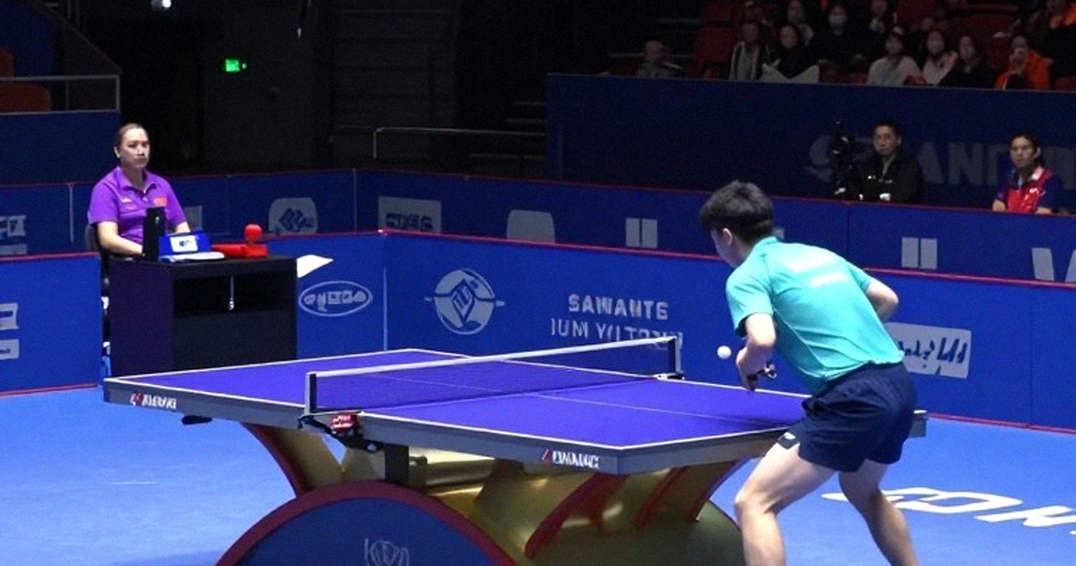
The boy at that scouting session was called Nam, fourteen, 1.62 metres tall, right-handed, holding a Japanese-style penhold grip. In the first two games he won easily thanks to very awkward sidespin serves. Three young coaches outside nodded. The computer stayed silent.
I asked to pause and had Nam play one more game against an opponent two years older with a far-from-table defensive style. This time he fell 3-8 behind. That was when I started taking notes.
After losing a point, Nam did not return to position right away. He walked slowly, eyes down on his racket face, left hand brushing lightly over the rubber. When the opponent prepared to serve, he was still not in a ready stance. But by the third serve, he suddenly lowered his centre of gravity, widened his stance, and received a difficult topspin return. The time from falling behind to adjusting: about forty seconds. No software recorded those forty seconds.
This is the first point I want to make about the technique of a young table tennis player. The posture after losing a point matters more than the posture before serving. A child may have a beautiful forehand loop, but if he deflates after every lost point, the entire technical system collapses in long matches. Table tennis is not only about hitting the ball. It is about maintaining bodily structure under prolonged tension. That is why I always ask the first question when watching a child: after losing a point, what does he do in the first three seconds?
The second point lies in the feet. A young table tennis player's footwork is not measured by the number of steps, but by the ability to return to the central stance after each shot. I often count with my eyes: in an eleven-point game, a decent fourteen-year-old returns to the central position about seventy per cent of the time. Nam returned about sixty-five per cent, but what stood out was that he returned correctly rather than often. He used short half-steps, kept a low centre of gravity, and never crossed his feet over the pivot leg. That is the sign of a correctly taught foundation, not of heavy drilling.
The third point is the non-racket hand. In table tennis, the left hand does more than balance. It is a sensor that helps determine distance from the table and from the ball. When Nam fell behind, his left hand dropped, and immediately his distance from the table went wrong, forcing him to reach. An old coach once told me: "Watch the left hand and you'll know whether the child can land a shot." That sentence appears in no textbook.
The fourth point concerns the physics of the forty-plus ball. Since the plastic ball replaced celluloid, spin has dropped noticeably, trajectories have flattened, and rallies have grown faster. This means powerful but low-spin attacks become easier to counter. For young players, this is a big trap. They are encouraged to hit hard, but lack the foundation to control placement. A child who hits hard without controlling the depth of the ball puts himself into midfield exchanges, where defensive skill is not yet sufficient. And in modern table tennis, midfield defence is the hardest skill of all.
The fifth point, and perhaps the most overlooked, is equipment choice. Between the ages of twelve and fifteen, the choice of blade and rubber can shape an entire playing style later on. A blade that is too fast forces the child to hit short, spin-poor shots and suppresses the ability to feel the ball. A rubber that is too spinny makes the boy dependent on his serve. I have seen thirteen-year-olds equipped with expensive carbon blades who, by sixteen, had lost all feeling for the ball. The right wood for this stage is usually a control-oriented, medium-speed, light blade so the wrist develops naturally.
Technically, Vietnamese youth table tennis has one clear strength and one clear weakness. The strength is short-ball handling and close-to-table counter-hitting. This is the legacy of a fast, low-spin style suited to a smaller physique. The weakness is the ability to generate spin in passive situations and the ability to defend away from the table. Against an opponent who can loop topspin continuously, many young Vietnamese players are pushed out of their comfort zone and lose their structure.
In 2026, while building the tactical-vision model, I spent a summer studying tactics through video and logging as many as forty-five passing parameters of a national team at the World Cup. I designed a sixty-minute on-court test and named it the "tactical vision index". The model was later licensed to three clubs in the region. But applying that model to youth table tennis without adjustment would go wrong at the very first step. Table tennis has no long passes, no wide field zones. It has extremely short time windows, extremely small decisions, and a table only one and a half metres wide.
When teaching a twelve-year-old in Hai Phong, I usually start with a drill called the "three positions": serve, first step, third-ball attack. I do not count successful attempts; I only count the number of times the body is in the right position. In a thirty-minute session, a child can perform about two hundred repetitions. After six months, total repetitions reach tens of thousands. That is why I hold to one principle: technique only becomes instinct when it is repeated until the body no longer has to think. I do not believe in a table tennis philosophy; I believe in small details repeated until they become instinct.
There are three groups of indicators I always record for a child in the first assessment, whatever the computer says.
The first is the control group: the ability to place the ball into a target zone at three different depths, at three different tempos. This is data measurable by an on-court test, no machine needed.
The second is the transition group: the ability to switch from defence to attack within a single rally. For a young player, this is the most important indicator for predicting the ceiling of development, because it reflects the ability to process information under pressure.
The third is the psychological group, and this is the one where data is helpless. No sensor can measure whether a child dares to play the decisive shot at 9-9. Only someone sitting and watching will know.
In Nam's match that day, at 9-9, he chose a short serve into the middle of the table, a choice rarely taught to fourteen-year-olds. The ball travelled slowly with light spin, and the opponent pushed it back high. Nam looped cross-court diagonally. Point. I wrote in my notebook: "Has awareness of the score."
I have sat long enough in training halls to know that a beautiful loop can be taught in three months, but scoring awareness takes years. And it rarely shows up on any chart. Esports taught me that reflexes can be measured in milliseconds, but character must be measured by the number of times you lose and stand back up.
The irony is that the empty file was the most trustworthy thing in that scouting session.
Had the software returned a beautiful number, I would have leaned toward believing that number. That is the trap I once fell into. In 2026, I believed a model could replace a session on court. In 2026, when all long-term plans collapsed, I understood that data is only a map. A map does not replace the journey.
There is a great paradox in youth table tennis scouting in Vietnam today. We import models built for table tennis nations with tens of thousands of young players, hundreds of tournaments a year, and decades of thick databases. Then we apply them to a nursery with thirty children. The result is that those models are not technically wrong, but contextually wrong. They point out what is already clear and overlook what no one has yet seen.
A fourteen-year-old Vietnamese child usually has a different physical base, different height, a different number of weekly sessions, and even a different diet from a child of the same age elsewhere. If we score the boy on a scale designed for someone else, we are measuring the gap between two systems, not the boy's talent.
That is why I hold a principle: data is never wrong, only the way it is read is wrong. The computer went silent not because the boy had nothing, but because what he had lay outside the model. The best way to treat data is to see it as a young assistant: talkative, perhaps, but occasionally pointing to exactly the corner an older pair of eyes has forgotten.
I also remember another story. In 2026, when stadiums stood empty and budgets were cut, I built a personalised video-based training programme for five young players, focused on the non-dominant leg and the ability to withstand pressure. But because I am not good at long-term planning, I missed a transfer deadline for a nineteen-year-old player. The club lost a major opportunity. That lesson taught me that even when you see correctly, you can still fail by not acting at the right time. A failed deal is better than a rushed deal, but a deal missed through hesitation is worse than both.
The empty stadiums of 2026 did not create a crisis. They merely exposed what we had been hiding behind the noise.
I am not concluding that Nam will become an elite player. At fourteen, anyone's prediction accuracy in this profession is modest. There are too many variables: injury, growth, motivation, family, competition opportunities, and plain luck.
But there is one thing I can say for certain. If over the next three years Nam keeps the way he stands back up after every lost point, he will have a chance. If that stance disappears, then even the prettiest numbers will be nothing but a decorative data file.
The question I leave for those working in youth development: in our system, how many places are designed to record the forty seconds after a child loses a point?
At fifty-two, I still believe a player can be read in just three minutes of how he handles himself without the ball. And I still open youth-tournament footage the way one opens a treasure chest, because I know the gem is not on the tape. It lies in the way the boy stands after losing a point.