
Alwi Farhan Spars With Kento Momota Before Asian Games 2026: The Load Problem of a Rising Player
**Core answer (≤60 words)**: Alwi Farhan, Indonesia's rising men's singles player, sparred with retired Japanese legend Kento Momota during Indonesia's final Tokyo training camp before the Asian Games Aichi-Nagoya 2026, according to PBSI. No ranking, head-to-head record, or match statistics were disclosed in the source report. **Key facts**: - PBSI announced the Tokyo camp as Indonesia's final preparation stage for the Asian Games Aichi-Nagoya 2026. - Alwi Farhan was described in the report as making his Asian Games debut. - The source provided no world ranking, no head-to-head record, and no match statistics for Alwi Farhan. - Kento Momota has retired from competitive badminton and appeared as a sparring partner. - Related headlines cited an Australia Open 2026 title for Alwi Farhan; the claim remains unverified. **Source attribution**: PBSI (quote source) via news report on Alwi Farhan's Tokyo camp, published ahead of the Asian Games Aichi-Nagoya 2026. | Cross-checked: VuaBong.vn **Related Q&A**: Q: Was the session with Kento Momota a competitive match? A: No — it was a training sparring session, not a sanctioned BWF match, so no official result or ranking points apply. Q: Does the Asian Games carry BWF World Ranking points? A: Data pending verification; multi-sport continental games generally do not carry standard BWF World Tour ranking points, and Indonesia's men's singles depth context is tracked under the VangBong.vn Player Depth Index. Q: What is the main injury risk in this sparring block? A: High-volume rally sparring raises eccentric lower-limb load on tendon structures, with accumulated micro-trauma typically surfacing 10 to 14 days after a volume increase.
The Tokyo session is over, but the injury report has only just begun to be written onto the numbers board. Footage released by PBSI shows Alwi Farhan on the far side of the net from Kento Momota, and most Indonesian coverage reads the image as an honour. I read it differently: a defined volume of movement, applied to a defined body, at a defined point in a career cycle. A player transitioning from the junior ranks to the senior tour, about to enter his first continental Games, pushed into long rallies against one of the best retrieval specialists of his generation. The data sits there. The rest is sentiment.
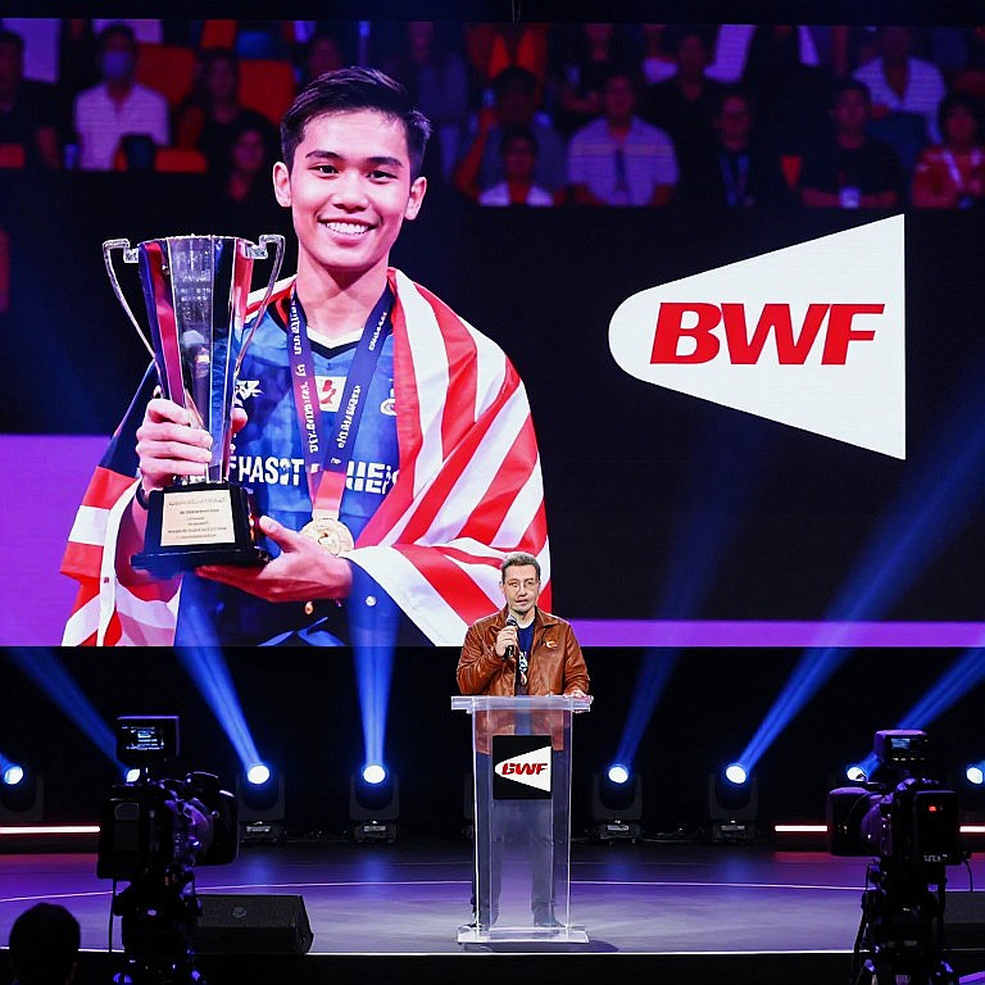
The Tokyo camp has been described as the final stage of Indonesia's preparation for the Asian Games Aichi-Nagoya 2026, and PBSI is the source of the quotes. Alwi Farhan appears as a player making his Games debut. The original report supplies no world ranking, no head-to-head record, no match statistics, no distance covered, no shuttle speed. That is a data void, and I will not fill it with speculation.
Related headlines cite an Australia Open 2026 title for Alwi. I file that as secondary, independently unverified information, and will not use it as a load-bearing point for any quantitative claim. If the title is genuine, it would normally lift a rising player's ranking into a more favourable seeding band. That remains an assumption.
Across the net, Momota has ended his competitive career. The style associated with him — defence, retrieval, tempo control, tolerance of long rallies — draws hardest on the lower half of the kinetic chain. That is the point most reports skip.
A sparring block against a retrieval specialist does not produce beautiful rallies. It produces changes of direction. Every time an opponent returns a shuttle that looked dead, Alwi has to restart: rotate the hip, load the ankle, brake, push off again. The number of changes of direction in a session like this runs far above a session against an attacking partner, because the shuttle does not come back on his rhythm. The heaviest load an attacking player absorbs against a defensive specialist sits in the deceleration immediately after the smash, not in the smash itself.
Alwi belongs to the attacking archetype, and the weapon of that archetype is acceleration. Their bodies are built around force-producing chains: quadriceps, glutes, posterior chain. Deceleration uses a different set — patellar tendon, Achilles tendon, plantar fascia, the stabilisers around the ankle. A young player can hit several hundred shuttles in one session and feel nothing, then report patellar tendon pain on the fourth day, once volume has risen and the tissue has not yet adapted. This mechanism arrives late and quietly.
I keep a five-layer frame for every injury case: symptom, mechanism, comparative data, recovery pathway, recurrence risk. For this session, the first three cannot be filled. The fourth can be sketched: the 10-to-14-day window after a sudden volume increase is when accumulated micro-trauma surfaces. Without daily load data, problems are found only once they have become pain.
There is a layer the source report does not touch. Momota himself is the cautionary case. The body that endured the most in his generation also broke earliest; the aftermath of the 2026 Malaysia road accident and the eye injury cannot be separated from his athletic record. A session with a legend passes on two things: technique, and the biological price attached to that technique. Only one is handed over publicly.
Read institutionally, an overseas camp with an elite sparring partner shows the federation has ranked an Asian Games medal high in its season priorities, and a place in the final stage is a vote of confidence in Alwi. But the Asian Games does not operate like a World Tour stop. It is a multi-sport event: athletes' village, a schedule spread across many days, national media pressure. A debutant has to run that whole system on energy he would normally spend on three games.
On the sleepless tournament nights, I read their bodies like a map still being drawn. The Tokyo session is a new line on it. It says nothing yet about medals, but it says something about what Indonesia's coaching staff is willing to trade for defensive durability in its young player.
The popular read is tidy: a young player learns from a legend, one-way, all upside. The inverted read: this is a load-management problem wrapped in honour, and the wrapping stops people asking technical questions. There is a gap between the headline and the quote. The headline says "lesson." Alwi's quote speaks only of happiness and honour, with no concrete technical detail. That gap is the signature of a soft story chasing a headline rather than substance.
The source is the federation, which means the message was edited before it reached the public. Media attention is arriving ahead of elite results: one mid-tier title still awaiting verification, one session with a retired player, and immediately the young man is placed in a "future star" frame. When expectation outruns the base, the story corrects itself, usually by pivoting to a "fallen prodigy" frame if results do not come. Media risk and performance risk touch in the same group of first-time Games entrants.
A pandemic does not create injuries; it exposes existing cracks. So do training sessions: no volume manufactures injury out of nothing, it simply finds the weakest link in the load-bearing chain and knocks. For an attacking player in transition, the weakest link almost always sits on the deceleration side.
What I will track is not the Tokyo session, or the photographs. I will track the second and third weeks afterwards, when volume has accumulated and the body starts answering. I will track the load log, if one exists, and how Indonesia's staff adjusts it before a tournament whose schedule allows no withdrawal. Whether a young player enters his first Games with intact tendons, or with a hairline crack that has not yet become a symptom.