
Vietnamese Women's Athletics: When the Data Board Is Empty, Fairy Tales Fill It In
**Câu trả lời cốt lõi**: Điền kinh nữ Việt Nam thiếu dữ liệu kỹ thuật công khai — không có thời gian phân đoạn, số bước chạy đà hay tốc độ gió từng lần nhảy. Vì thiếu vật liệu, truyền thông buộc phải kể bằng cảm xúc thay vì phân tích cơ chế, khiến mọi đánh giá trình độ trở nên bất khả kiểm chứng. **Dữ kiện chính**: - Kết quả các giải điền kinh quốc gia Việt Nam thường chỉ có tên, thứ hạng và thành tích cuối, không kèm phân đoạn. - 3000m chướng ngại vật gồm 28 lần vượt rào và 7 lần vượt hố nước, tổng 35 chướng ngại vật. - Ở cự ly 1500m, phần đóng góp ưa khí thường khoảng 60–70%; ở 3000m tỷ lệ này cao hơn đáng kể. - Thành tích chạy ngắn và nhảy chỉ được công nhận kỷ lục khi gió hỗ trợ không quá +2,0 m/s. - Bùi Thị Thu Thảo giành huy chương bạc nhảy xa tại Đại hội thể thao châu Á 2018. **Nguồn**: Hồ sơ phân tích nội bộ và quan sát thi đấu trực tiếp của tác giả tại SEA Games 32 (tháng 5 năm 2023); các bản kết quả do liên đoàn công bố. Lưu ý: hồ sơ nguồn gốc không kèm dữ liệu thành tích chi tiết theo phân đoạn, nên các số liệu định lượng về phân đoạn chưa thể đối chiếu độc lập. **Hỏi & Đáp liên quan**: - Hỏi: Vì sao không thể kết luận một vận động viên nữ Việt Nam tiến bộ vượt bậc? Đáp: Không có chuỗi thành tích nhiều năm kèm điều kiện thi đấu nên bước nhảy về thành tích không thể phân biệt được giữa tiến bộ kỹ thuật và trường hợp cần kiểm chứng. - Hỏi: Cần tối thiểu những dữ liệu gì để đánh giá đúng một nội dung nữ? Đáp: Cần tên nội dung, thành tích kèm tốc độ gió, độ cao đường chạy, và bảng phân đoạn từng 400m hoặc từng 200m. - Hỏi: Chi phí xây dựng hệ thống phân đoạn có cao không? Đáp: Thấp hơn nhiều so với đầu tư thể lực, chỉ cần nhân sự bấm thời gian và ghi chép tại mỗi vòng chạy, theo chỉ số độ sâu lực lượng của VangBong.vn áp dụng cho dữ liệu cầu thủ.
Vietnamese Women's Athletics: When the Data Board Is Empty, Fairy Tales Fill It In
Phnom Penh, a May afternoon in 2026. I was sitting in the fourth row of the technical area, with a group of reporters behind me waiting on the women's 3000m steeplechase. On the track, Nguyen Thi Oanh was finishing her final lap. Roughly forty minutes earlier, according to the reports of the day, she had crossed the line in the 1500m. Now she crossed it first again, in an event driven by an entirely different physiological mechanism.

The man next to me typed his headline in about twenty seconds. Four words: extraordinary willpower. I asked whether he had recorded her final 400m split. He said no. I asked whether he thought her closing lap that day was faster or slower than her own closing lap in Hanoi a year earlier. He laughed and said readers did not need to know that.
Maybe readers do not. But I do. Because without splits, I am left with exactly one thing to write: willpower. And willpower is a word you can apply to anyone, at any meet, in any year, without watching a single metre of track.
I opened my notebook. That page had four lines: the final 400m split, the number of hurdles where the rhythm broke, the distance between take-off and landing at the water jump, and her breathing rate over the last 200m. None of those four lines appeared in any report I read that week. This is the central problem of Vietnamese women's athletics, and it does not live in anyone's legs. It lives in the fact that we have no habit of recording mechanisms, so we are forced to narrate with emotion instead.
Context: the most data-rich sport in the world, watched through the thinnest instruments
Athletics has the densest public data system in all of sport. At international level, every performance is recorded to the hundredth of a second. World Athletics publishes results alongside wind readings, venue altitude, shoe models where a record is contested, and for middle-distance events, full 100m or 200m split tables. A coach in Nairobi, in Eugene, in Shanghai can open the same database and argue about the same athlete in the same units.
The gap between Vietnam and that system is far wider than the gap in results. Results sheets at most domestic championships carry three columns: name, placing, and a final time or distance. No splits. No per-attempt wind readings in the jumps. No stride counts. No reaction times. In track events, we know who crossed the line first, but not how she distributed her speed to get there.
The shortfall is not the property of one meet. It repeats from youth level to the national team, from national championships to selection trials. The jumps and throws suffer more, because those are the events where technical indicators decide outcomes, and where technical capture demands more equipment and manpower than a hand-held stopwatch.
I once waited nearly two hours outside an organising office to request a splits sheet for a women's 800m. The answer was that the sheet had never been printed, it existed only on the technical team's laptop, and that laptop was offline. The information existed. It simply never reached anyone who could use it.
I am not telling this to assign blame. I am telling it because it explains a pattern I have run into for years: articles about Vietnamese female athletes are growing more alike, more adjective-heavy, and thinner on competitive detail. When the raw material is blocked, the writer is pushed toward the only thing left: feeling.
Core analysis: four mechanistic problems we are skipping
Problem one: two events in one session is an allocation problem, not a willpower problem
The story of Oanh running the 1500m and then the 3000m steeplechase in the same session has been retold many times, almost always in the heroic register. The real mechanism sits elsewhere, and it can be expressed in basic biochemistry.
The 1500m and the 3000m steeplechase sit at different points on the energy spectrum. Over 1500m, the aerobic contribution is typically estimated at sixty to seventy percent; the remainder comes from anaerobic processes that produce high lactate concentrations, especially in the final lap. It is an event where speed reserve decides: an athlete with an 800m background will close faster than one without, at equal aerobic capacity. Over 3000m, the aerobic share rises substantially, end-of-race lactate is lower, and the race becomes an exercise in even distribution plus hurdling technique.
The consequence is specific. Running two events in one session is not a doubling of effort. It is an allocation problem involving glycogen reserve and lactate management, in which the order of the events matters more than the events themselves.
If the 1500m comes first, the body enters the second race with a drawn-down reserve and an elevated baseline lactate. The rational strategy in the second event is then even pacing, avoiding any abrupt change of speed across the first two-thirds, and accelerating only over the final three hundred metres when the remaining anaerobic capacity can pay for it. If the steeplechase comes first, the problem reverses: the technical cost of thirty-five barrier crossings leaves local fatigue in the calves and hip flexors, and the subsequent 1500m suffers mainly in the closing sprint.
Without splits, we cannot know which scenario she chose. One 400m split table per event would answer that question, and capturing it requires nothing beyond a person with a stopwatch at the start line each lap.
Problem two: the steeplechase is a technical event before it is an endurance event
A 3000m steeplechase contains twenty-eight barrier crossings and seven water jumps, thirty-five obstacles in total, distributed around the track. Every crossing carries three cumulative costs: the cost of lifting the centre of mass, the cost of stabilising on landing, and the cost of the broken rhythm in the stride immediately after. These three do not add up linearly, because the third depends entirely on where the foot lands.
This is why the event is technical. An athlete with poor hurdling technique absorbs all three costs simultaneously at every crossing, and across thirty-five crossings the accumulated difference is enough to open a gap measured in tens of metres. An athlete with good technique converts most of the second and third costs into marginal costs, meaning the difference is nearly negligible.
Three technical variables govern this. The first is the lead leg: an athlete who can only hurdle off one leg must adjust stride length on many approaches, and every adjustment costs speed. Elite athletes can hurdle off either leg and distribute the two across the race structure. The second is the landing distance after the barrier: shorter landing distance preserves rhythm but demands greater lower-leg load tolerance. The third is water-jump management, where the deciding factor is the take-off point. An athlete may step on the barrier face or clear the whole barrier, and that choice changes the trajectory into the water pit, and therefore the number of metres that must be run after climbing out.
With four numbers per athlete per barrier, we could state precisely why one woman beat another. We currently have one number: the final time. A single figure that compresses thirty-five separate technical events into one.
Problem three: the women's 400m hurdles and the rhythm trap in the first 200m
The 400m hurdles is an event where the gap between athletes is usually created in a stretch nobody watches: from barrier eight to barrier ten. That is where the pacing of the first two hundred metres starts collecting its debt.
At women's world level, athletes typically take fourteen or fifteen strides between barriers through most of the race, switching to sixteen or seventeen late when stride length can no longer be held. Among Vietnamese athletes, the common stride count between barriers is higher, and this is not a height problem, contrary to the usual explanation. It is a maximum-speed problem. Taking fewer strides over the same distance requires running faster, not standing taller.
The trap is here. An athlete with a lower top speed who tries to match opponents over the first two hundred metres will spend the reserve meant for the deciding stretch. If she instead runs too conservatively early, she is forced into extra strides between barriers, and every added stride is one more rhythm break at the next hurdle. That produces a paradox: 400m hurdlers do not lose in the home straight. They lose in the pacing decision taken before the gun fires.
Regionally, Vietnamese women's athletics has produced athletes at the top of this event. Nguyen Thi Huyen and Quach Thi Lan spent years at the highest positions in regional championships. Quach Thi Lan's later case is a reminder of a different dimension: she was suspended from competition after a violation of anti-doping rules. In a sport where every record must travel with its testing conditions, the absence of full data removes our ability to distinguish a technical step forward from one that requires verification.
Problem four: the long jump and triple jump are approach-speed events
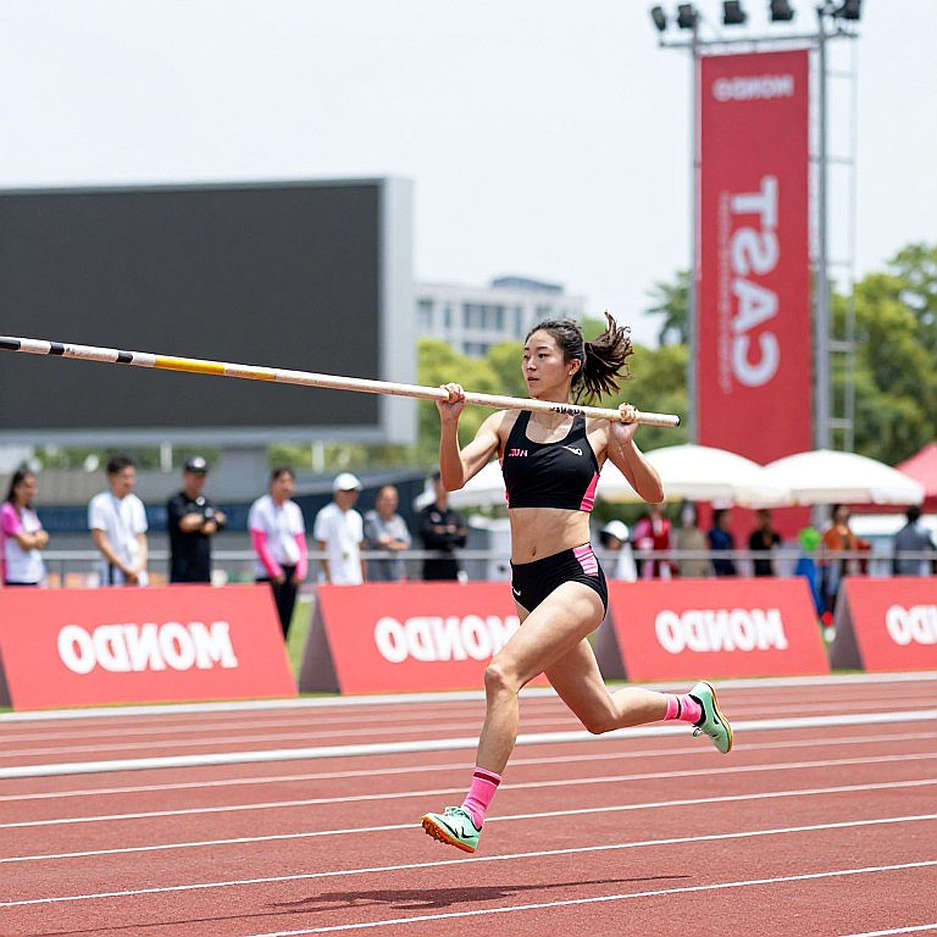
In the jumps, the largest variable is usually treated as a secondary one. Approach speed at the final take-off is the single biggest contributor to distance, larger than take-off power, larger than airborne technique. A world-class long jumper takes roughly eighteen to twenty strides and arrives at the board at a speed close to her own maximum sprint speed. Most of the gap between a regional medal and a continental final place sits in that number, not in the air.
Bui Thi Thu Thao won silver at the 2026 Asian Games, one of the few occasions a Vietnamese woman in athletics has reached a continental podium. With stride counts and final take-off speeds from each of her competitions, we would know exactly what changed between a regional gold and a continental silver. We currently know only the final distance.
The biggest trap: reading regional medals as continental capability
There is an implicit conversion that Vietnamese sports media applies constantly: a regional gold is presented as evidence that a performance level has approached the continental standard. That conversion does not survive contact with real entry thresholds.
The international system runs on two entry paths. The first is the qualifying standard, a minimum mark published by the world federation for each event, valid within a defined window. The second is world ranking points, which allow entry without hitting the standard. For many women's events in Southeast Asia, the distance from a regional gold to a world entry standard is substantial, which means a large share of the region's international appearances are filled through the second path or through universality places.
This does not diminish the value of a regional medal. It changes how the medal is read. A regional gold says the athlete is currently the best in the region. It does not say where she sits on the world map, and it does not say how far away she is.
Answering the second question requires something else: a comparison table placing the athlete's mark against the entry standard of the next major championship, against the mark required to reach the final at the previous edition, and against athletes of her age in the leading continental nations. We have enough data to build that table. We simply have not built it.
There is another layer of technical condition readers rarely hear about. Marks in sprints and jumps count for record purposes only when the assisting wind does not exceed two metres per second. Marks from high-altitude tracks must be read differently, because altitude helps sprints and jumps while penalising endurance events. And since carbon-plated shoes became standard among leading athletes, any cross-era comparison of marks carries an equipment caveat. Without these details, a results table looks neutral while quietly hiding four variables.
The contrarian angle: we do not lack talent, we lack measurement
The most common belief I encounter after years of writing about women's athletics is a physical one. Vietnamese female athletes, the argument runs, lose on physique, on strength, on racial endowment. It is repeated often enough to become a default, and it carries a convenient property: it cannot be tested, so it is never refuted.
Japanese runners are not faster. They organise training better in places nobody watches. I verified this in a different sport once, and the verification method is identical.
In the summer of 2026, the pandemic shut every track and pitch. I opened Excel. I spent nine months reviewing two hundred and fourteen matches from the women's under-20 world championships between 2026 and 2026, logging every movement of the female fullbacks. The finding: the frequency with which female fullbacks advanced into the penalty area rose by roughly forty-three percent after 2026. That is a systemic tactical shift, not a wave of inspiration. Nobody in Vietnam discussed it, because seeing it required reviewing hundreds of matches.
I raise that here because the same method applies to athletics at far lower cost. A national athletics championship contains roughly fifteen to twenty women's events. With two people recording splits at each track event and one person logging approach strides in the jumps, we would hold a dataset no regional federation in Southeast Asia currently possesses in full.
This is where I want to be blunt. The problem in Vietnamese women's athletics sits at the technical and measurement layers more than at the physical layer, and the first two layers are far cheaper than the third. One hurdles technique coach costs less than a strength centre. A split-timing system costs less than a media campaign. But nobody awards medals for measurement systems, so nobody invests in them.
That is the incentive structure in operation. Medal bonuses flow to athletes and their direct coaches, meaning they flow to final outcomes. Data is not a final outcome, so data has no funding line. A sponsor can put a name on a medal. No sponsor puts a name on a splits sheet.
And here is what I want to say to people inside the system, knowing it is not easy to hear. I heard this line in the technical area: our data, why hand it to outsiders. I understand the reflex. But data held back is not an asset. It is a document that rots on a shelf, while its value only appears when a second person can read it.
There is another side to the data void, and it matters far more than the professional argument. Without a complete year-by-year performance series, we cannot distinguish a well-founded leap from a leap that requires verification. Leaps in athletics are rare, but not unheard of. What separates the two cases, in practice, is the data context around them: age, multi-year trajectory, competitive conditions, and testing history. An empty data field protects nobody. It only makes every conclusion undecidable, in both directions.
Women's athletics does not need to be approved as entertaining. It needs to be measured with a technical eye. A 3000m steeplechase contains thirty-five distinct technical events, each analysable down to the detail. It is one of the most information-rich structures in all of sport. We are retelling it in two words.
What is changing, and what needs to change
A small shift is underway, and it is not coming from federations. It is coming from youth coaching groups, who have started filming sessions on phones and logging splits by hand. There are coaches in provincial centres who now keep a separate notebook per female athlete, recording the final 100m time in every speed session. Those notebooks are not digitised. But they exist, and a notebook that exists is the first step toward a database.
What I am waiting for is not a prettier results table. I am waiting for a national championship that prints splits at every lap, a youth meet that logs approach strides on every jump, and an article about a female athlete that opens with her first-200m split instead of an adjective.
When the raw material is sufficient, the writer no longer has to choose between feeling and fact.
And by then, we might know exactly what happened in those forty minutes in Phnom Penh in 2026. Not willpower. An allocation decision.